Monty Hall Problem
AI GENERATED / JEREMY CURATED
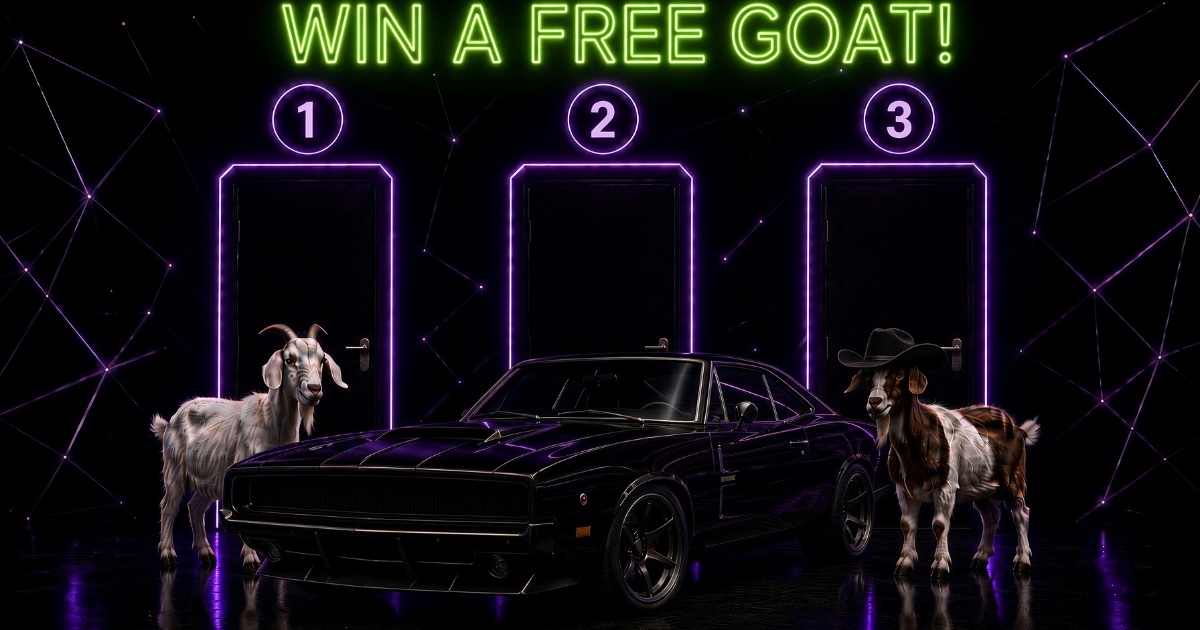
You're the contestant. Three doors. Behind one of them is a car. Behind the other two are goats. You pick a door. Any door. Say Door 1. You have no idea what's behind it. At this moment, your odds of having the car are 1 out of 3.
Now Monty steps in. He knows what's behind every door. He always opens a different door that has a goat. He never opens your door. He never opens the car if it isn't already yours.
He opens Door 3. Goat.
Two doors left closed: yours (Door 1) and Door 2. Monty looks at you and says: want to switch to Door 2?
Stay, switch, or does it not matter at all?
That's the whole question. Sit with it before you keep reading.
The scandal
In 1990 a reader mailed that setup to Parade magazine's "Ask Marilyn" column.
Marilyn vos Savant wrote the column. Guinness had listed her as the person with the highest recorded IQ on Earth. She answered it in two sentences.
The country lost its mind. About 10,000 letters. Nearly 1,000 from people with PhDs. Math professors called her an idiot. One asked how many irate mathematicians it would take to change her mind.
It hit the front page of The New York Times. Classrooms nationwide started running the experiment. Monty Hall even tried it in his living room.
People's guts scream 50-50. Two doors left. Equal chance. That feeling is stubborn.
Don't take my word for it
Before I tell you the answer, go get it yourself. I built the game so you can watch it play out a couple hundred times instead of arguing about it.
Whatever the two columns say after 200 rounds, that's the answer. The rest of this is just why.
Erdős and the 100,000 runs
Paul Erdős was one of the most prolific mathematicians who ever lived, and he did not buy it either.
Andrew Vázsonyi ran a computer simulation 100,000 times and put the output in front of him. Stay won about 1/3. Switch won about 2/3.
Erdős watched the numbers. He accepted that switching won more often. He still said he did not understand why.
Vázsonyi showed him a decision tree. Didn't land. Erdős wanted a simple reason, not a diagram.
That's the part worth sitting with. A man who could see through problems nobody else could touch looked at a correct proof and said, essentially, I believe you and I still don't get it. If it did that to him, the fact that it does it to you is not a knock on you.
(The simulation above has a button for the same 100,000 runs, if 200 still feels like it could be a fluke.)
The answer
Switch.
Your first pick never stopped being a 1/3 shot. Monty did not add new information that made your door better. He only burned a goat from the other pile.
Napkin math:
- Car is equally likely behind Door 1, 2, or 3. Each starts at 1/3.
- You lock Door 1. Probability it is the car: still 1/3.
- Probability the car is in the other two doors combined: 2/3.
- Monty must open a goat from those other two. He is forced. So the entire 2/3 pile collapses onto the one door he did not open.
- Stay = 1/3. Switch = 2/3.
That's it. Switching doubles your chance.
And here's the simple reason Erdős wanted. Monty's door is not a coin flip, it's a filter. He looked at both of the doors you didn't pick and deliberately removed a losing one. The door he leaves closed is the survivor of a search. Yours is just the one you happened to touch first.
The intuition
The cleanest way to feel it: imagine 100 doors. One car, 99 goats. You pick Door 1. Monty, who knows everything, opens 98 goat doors and leaves one other door closed.
Do you stay with your original 1-in-100 guess, or take the door he refused to open? You switch. Instantly.
Three doors is the same trick with worse camouflage.
Run it 30 times on paper or with cups. The pattern shows up faster than the argument does — or let the simulation run 200 of them for you and watch the two numbers separate.